

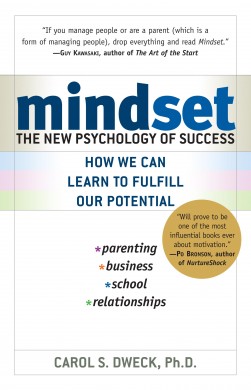
Make no mistake, this is definitely a pop psychology book, but I felt like it was eye-opening to some of my bad habits.
You see, I'm someone that has always prided myself in being willing to do anything once (it comes with marrying a redneck, I guess). At least, I try to do anything once before I form an opinion on it. However, that isn't always the healthiest mentality, I've come to realize. While it is great that I am willing to try crawdad fishing with bacon or frog catching with my bare hands, once I've done it, if I didn't like it, I can cross it off of my list, never to try again.
And don't get me started on if I was good at it or not. That is a whole 'nother issue. Let's just put it this way: I don't like doing things that I am bad at. Being able to say that I've at least tried to do it once is simply a naughty habit I've gotten myself caught in. If I didn't like it, I am now under the impression that I never have to do it again.
The beautiful thing about this book was that it opened my eyes to these bad habits. It didn't spell them out for me, I definitely had to stumble upon those revelations on my own, but I feel like now that I've learned about the fixed mindset and the growth mindset, I'm more aware of when I'm holding myself back.
The fixed mindset is a trap I think a lot of us fall into. It is very easy to think that we aren't good at something and therefore write it off entirely. It's also extremely easy to believe that we are bad at something before ever trying it, and therefore never adventure to see what else lies in store for us. It's also incredibly easy and very human to think that failing at something means that we are a failure. Why on earth do you think so many people hate math?! This book highlighted real-life examples of people that fall into the fixed mindset. For example, let's say you get a C- on an exam. What is your mentality? Was it the teacher's fault for making too hard of a test? Would you stop studying for the next exams, knowing that you've already lost out on an A in the class? Would you set a goal to study harder and longer for the next test? Would you look at your studying habits and see what you could do differently? Would you see yourself as a failure?

How about this: let's say you are extremely talented in an independent sport, like tennis or running or even croquet. One day you challenge someone to a game and you lose. Does this mean that you would stop playing that sport? Would you resolve to practice harder? Would you blame the conditions of the game? Break something, possibly? Ask for a rematch? Go home and do nothing? Pout?
Those that live in the fixed mindset believe that you either have talent or you don't. If you aren't good at something, give it up. If you are good at something, then don't try to take on too challenging of tasks because you might fail, and that failing is a direct reflection of you as a person rather than a chance to change.
By telling myself to try anything once, I was sticking myself into this fixed mindset box. I was looking for things that I was naturally talented in, and quickly finding out what I wasn't so that I could avoid those things. Reading this book helped me to realize that I have every opportunity to grow from experiences. I can look at any situation two ways: is it challenging me to become better or is it challenging me and my sense of self.
There are so many personal revelations I had while reading this book. I would challenge you to read it. I recognize that at times it gets a little repetitive, and for those of you that are actually psychology students or experts, it does breaks some psychology rules - such as labeling and putting people into boxes. I also recognize that this is a pop psychology book and therefore it doesn't really have much scientific data written into the actual book. However, my challenge still stands. Read it and see if you discover anything about yourself, even if it has nothing to do with either mindset. If you do read it/have read it, please comment below! I would love to talk to you about it!

This was my reaction to my older sister starting another school year while I was still too young to go to school.
This is still my reaction towards starting my senior year of college, chunky cheeks, china eyes, and all.

This cute little thing is already 2 months old!
Zane has learned how to pull mom's hair, pull mom's shirt down, and how to pull on mom's nose. He is exploring and growing like crazy. He smiles practically on demand and is stealing hearts left and right.
Since clipping his tongue, Zane has begun to eat even more furiously than before. I'm lucky that he has not yet figured out what a carnivore is. I seriously fear the day this boy gets his first tooth.
On Monday I go back to school and this little guy will be babysat (still to be determined by whom). I'm sad to leave the little guy but I am adamant about finishing my schooling. I love this little peach more than life itself.

Despite the title, this is not a Huggies or a Pampers diaper commercial. It is, in fact, the very wording I used to tell my husband that our son's anterior tongue-tie has been cured!
Zane seems to take after his dad in every way, literally including having a tongue-tie. Both Mitch and Zaney-boy were born with tongue-ties. The only difference is that Mitch's was taken care of right after he was born while the hospital told us that Zane's didn't need to be snipped.
Long story short, it needed to be snipped.
Every time the poor little guy tried to breastfeed, he would end up leaking a majority of the milk he had worked so hard to get, out of the corners of his mouth. No joke, I would have to change shirts or pants almost every time I fed him or else sit in stinky, breast-milky clothes for the rest of the day. It was aggravating not only for me, but I could tell that Zane was frustrated trying to nurse as well. He took a long time to latch on and if I moved my arms or twisted my torso even slightly while he ate, his latch came undone and we were back to latching on again for another 5 minutes. Heaven forbid I tried to feed him after he had gotten frustrated because that only slowed down the process even more.
Thankfully, moving back to Rexburg had some of its perks: one being that our new Pediatrician was willing to clip Zane's tongue.
All they did was take a tongue depressor that was shaped like Mickey Mouse's head, ears and all, and stick it under his tongue, with the frenulum in between "Mickey's ears." Then they used some medical scissors and just snipped the frenulum until it was good to go! Zane hardly cried and the instant he saw me after this little 'procedure', he was happy and smiling again. Little blood, little tears (from Zane or Mommy), and little time.
Mitch said that if he had known that was all they would do, he would have cut it with a pocket knife - and that is why, ladies and gentlemen, you don't marry a redneck.
I am so grateful for the Rexburg Pediatricians that didn't just accuse me of being a first-time mom, that listened to my concerns, and did something about it. Breast feeding has already improved and Zane had such a little reaction to the entire process, I'm not sure why they wouldn't just do it in Washington!
We've joked around that Zane has had the "double-snip." Poor little guy's first girlfriend is going to just love us now, isn't she?
(Also, is it creepy that I took a piece of the tissue paper they laid him on? Mitch keeps telling me I'm being creepy, but there is a definite difference between "keeping all of your children's baby teeth" creepy and "something for the baby book" creepy, right? Please tell me it's not creepy... cause I've already done it twice now...)

I've been collecting things for quite some time now to make my "dream nursery" without really knowing what I wanted my dream nursery to be like. I've been scouring pinterest looking for inspiration for my little guy, despite college living.
I guess what I am most looking forward to is him having his own little place for diapers and wipes and everything else he could possibly need. A space for him to crawl and to play. A space where exploring and making messes is totally okay.
It didn't take long for me to find The Boo and the Boy on pinterest. I've been drooling over their spaces for weeks trying to figure out how I could afford pieces like those. College budget or not, I don't want to have junky furniture or pieces that will only be relevant while Zane is still very young. I want it to be able to smoothly transition to a big-boy room and even into a child's room without having to change too many things (a.k.a, only the crib).
So, without further adieu, I present the small tiny space that I have actually decorated while cropping out all of the clutter elsewhere!

I'm in love, I'm in love, and I don't care who knows it! I'll definitely update some more as I unpack things and find the will power to breastfeed, get dressed, and decorate my home in one day.


